
What You Should Know About Venomous Snakes in the Bergen County-Northern NJ Area: Last updated May 2026
As you take to the great outdoors for nature hikes or even yard work during the warmer months, there’s always a chance you might encounter one of the 22 snake species found in New Jersey. The good news is that Bergen County residents are much more likely to encounter one of the region’s non-venomous species, such as the common eastern garter snake or the black racer than they are to ever run into a venomous snake.
Yes. Two venomous snake species can be found in the Bergen County region: the northern copperhead and the timber rattlesnake. Both are rare and generally avoid humans.
Where Are Venomous Snakes Most Likely to Be Found in North Jersey?
Venomous snakes in North Jersey are typically associated with remote, undeveloped habitats that include rocky terrain, forested hillsides, wetlands, and steep wooded areas. In the Bergen County region, hikers and outdoor enthusiasts are most likely to encounter snakes in or near the Ramapo Mountains, the Palisades Cliffs, and other sections of the nearby Highlands region that extend into Passaic and Sussex counties.
Enjoy Nature But Use Common Sense
When enjoying the great outdoors, it is important to use common sense and be aware of your surroundings. This is particularly important in places such as the Ramapo Valley County Reservation area, heavily wooded park areas in the Highlands Region, along the Palisades, and in neighboring communities with lots of forest, marshy wetlands, or rocky, mountainous terrain in Bergen, Passaic, and Sussex Counties in northern New Jersey and Rockland and Orange Counties in New York.
If you are spending time outdoors in these areas, you should also familiarize yourself with the appearance, habitats, and habits of the area’s venomous snakes. Always watch where you’re stepping when walking on nature trails and keep dogs leashed.
What Should You Do If You Encounter a Snake?
If you encounter a snake of any kind, keep your distance and leave it alone! If you find a snake on your property and you have reason to believe it may be venomous, contact your local police department. Under New Jersey’s Endangered and Non-game Species Conservation Act, it is illegal to kill, harm, harass or collect any native, non-game wildlife, including snakes.
Are Venomous Snakes Common in Bergen County?
While venomous snakes can be found in Bergen County, encounters are rare. According to the New Jersey Department of Environmental Protection, the northern copperhead and timber rattlesnake typically avoid humans and are most often found in remote, wooded, rocky, or wetland habitats. Most snakes seen in Bergen County are harmless, non-venomous species such as eastern garter snakes, black racers, and northern water snakes.
Areas near the Ramapo Mountains, Palisades Cliffs, and heavily wooded parklands in Bergen, Passaic, and Sussex counties provide suitable habitat for both northern copperheads and timber rattlesnakes. Sightings are uncommon, but hikers and outdoor enthusiasts should always stay alert and avoid reaching into rock crevices, brush piles, or tall grass.
Venomous and Common Non-Venomous Snakes Found in the Bergen County Area
While only two venomous snake species are found in the Bergen County and North Jersey region, several harmless snakes are commonly seen in parks, neighborhoods, wooded areas, and near local waterways.
Two types of venomous snakes can be found in Bergen County. The northern copperhead and the timber rattlesnake are reclusive and shy, but each will defend itself if threatened. Fortunately, you’re not likely to encounter either snake, and you have a greater chance of being struck by lightning than ever being bitten by one of these venomous reptiles.
Here’s a quick guide to some of the snakes Bergen County residents and hikers may encounter in the area:
| Snake | Venomous? | How Common in Bergen County Area? | Typical Habitat |
|---|---|---|---|
| Northern Copperhead | Yes | Rare | Rocky hillsides, wetlands, wooded areas |
| Timber Rattlesnake | Yes | Rare | Forests, rocky ridges, remote hillsides |
| Eastern Garter Snake | No | Very common | Lawns, gardens, parks |
| DeKay’s Brown Snake | No | Very common | Gardens, mulch beds, suburban yards |
| Black rRcer | No | Common | Woodlands, fields, suburban edges |
| Northern Water Snake | No | Common near water | Lakes, streams, marshes |
Venomous Snakes in the Bergen County-North Jersey Area: The Northern Copperhead
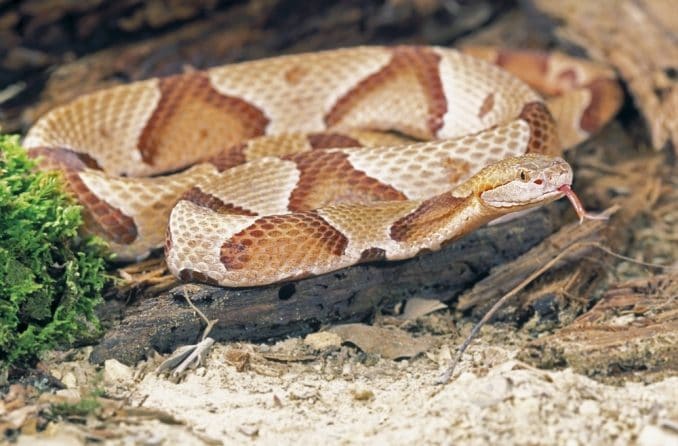
The northern copperhead is a venomous snake with a broad triangular head, vertically elliptical pupils, and a heat-sensitive pit between each eye and nostril. The body is pinkish to grayish brown with brown or reddish-brown crossbands narrow on the back and widest on the sides. Small dark spots commonly occur between crossbands on the back. The unpatterned head is dull orange, copper, or rusty-red. Body scales are keeled, and the belly is pink or light brown with dark blotches along the sides. When young, a copperhead has a yellow-tipped tail.
Copperheads prefer rocky, forested hillsides and wetlands for habitat. Wet areas are particularly sought out in the hot summer months. In recent years, sightings have been reported along the Palisades in the Tenafly area and the Ramapo Valley County Reservation area near the Mahwah/Oakland border.
When approached, copperheads will either move away quietly or lay motionless, relying on camouflage to protect them. Occasionally, they will vibrate their tails. Bites usually occur when people unknowingly step on or touch unseen snakes. Despite the venomous nature of copperhead bites, they are rarely fatal. In New Jersey, copperheads are so rare and reclusive that people seldom encounter them.
The copperhead is one of northern New Jersey’s least common snakes and is frequently confused with the northern water snake and the eastern milk snake.
You should never disturb this snake.
Venomous Snakes in the Bergen County-North Jersey Area: The Timber Rattlesnake
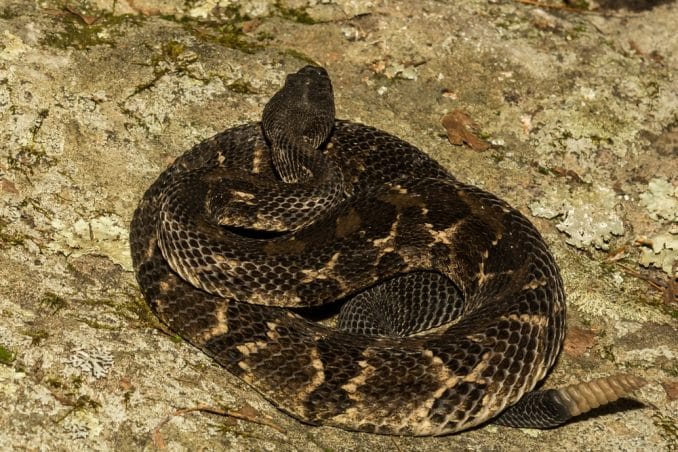
The timber rattlesnake is a heavy-bodied snake with a broad head that is distinct from its narrow neck. The top of the head is unmarked and usually yellow to light gold in color. Adult timber rattlers average 35 to 50 inches in total length. They have a yellow, brown, rust-orange, or in rare cases, gray ground color with black or dark brown crossbands extending along the back. There is a dark brown stripe behind each eye, and there may be a rust-colored middorsal stripe from the neck to the tail. The tail is short and thick, all black, and tipped with a tan rattle. Juvenile timber rattlers typically have the same markings as adults.
The timber rattlesnake can be found in three distinct areas – the Kittatinny Ridge and the northernmost portion of the Highlands and the Pine Barrens in southern New Jersey. Each year, multiple sightings are reported in the Ramapo Valley County Reservation area and other nearby Passaic and Sussex County, New Jersey communities. Timber rattlesnakes also inhabit Rockland and Orange County communities in New York. Timber rattlesnakes are typically found in bluff areas, rocky ledges, fields, and oak woodlands in relatively remote areas. They prefer rocky outcrops and open grassy areas with southerly exposures in the spring and fall. During the summer, they inhabit forests and open valleys.
Timber rattlesnakes are not a major threat to humans. This snake has a secretive nature and prefers those areas that are mostly unused by humans. Timber rattlers prefer to remain quiet, relying on their cryptic coloration to go unnoticed. They often are reluctant to rattle, preferring not to call attention to themselves. The timber rattlesnake is quite docile unless provoked. They can be defensive if disturbed and will bite. While the timber rattlesnake has its rattle to distinguish it from other snakes, many other snakes in the Bergen County area, including black rat snakes, black racers, and northern water snakes, mimic the rattlesnake by vibrating their tails on dry leaves and other objects.
Are Black Snakes in Bergen County Venomous?
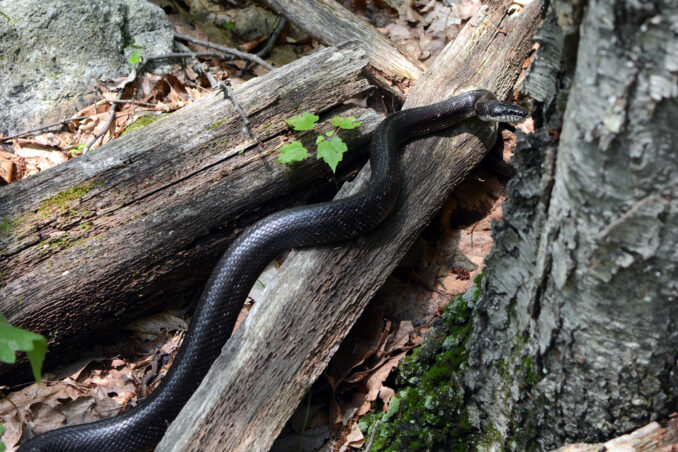
Black snakes commonly seen in Bergen County, including black racers and black rat snakes, are not venomous. These snakes are often mistaken for more dangerous species because some will vibrate their tails when threatened or flatten their bodies defensively. In most cases, black snakes found in yards, parks, and wooded areas in North Jersey are harmless to humans. However, they will bite if cornered or handled. Leave them alone.
This New Jersey Snake Reference Guide provided by the New Jersey Department of Environmental Protection can be a helpful resource for those planning nature walks in Bergen County.
Safety Measures to Remember
If you encounter a snake while hiking, gardening, or spending time outdoors in Bergen County or North Jersey, wildlife experts recommend keeping your distance and leaving the animal alone. Never attempt to touch, move, corner, or kill a snake. Most bites occur when people try to handle snakes or accidentally step on them in rocky or wooded areas. Dogs should always remain leashed on hiking trails and nature paths.







Share this mybergen.com post!
What to do if you encounter a bear in North Jersey.
Things to do in Bergen County this week!